Tireless Socks

  • 2026年03月18日
#patent #trademark

I would like to introduce patented products that we often see without giving them a second thought.
This time, I will be introducing “Tireless Socks.”

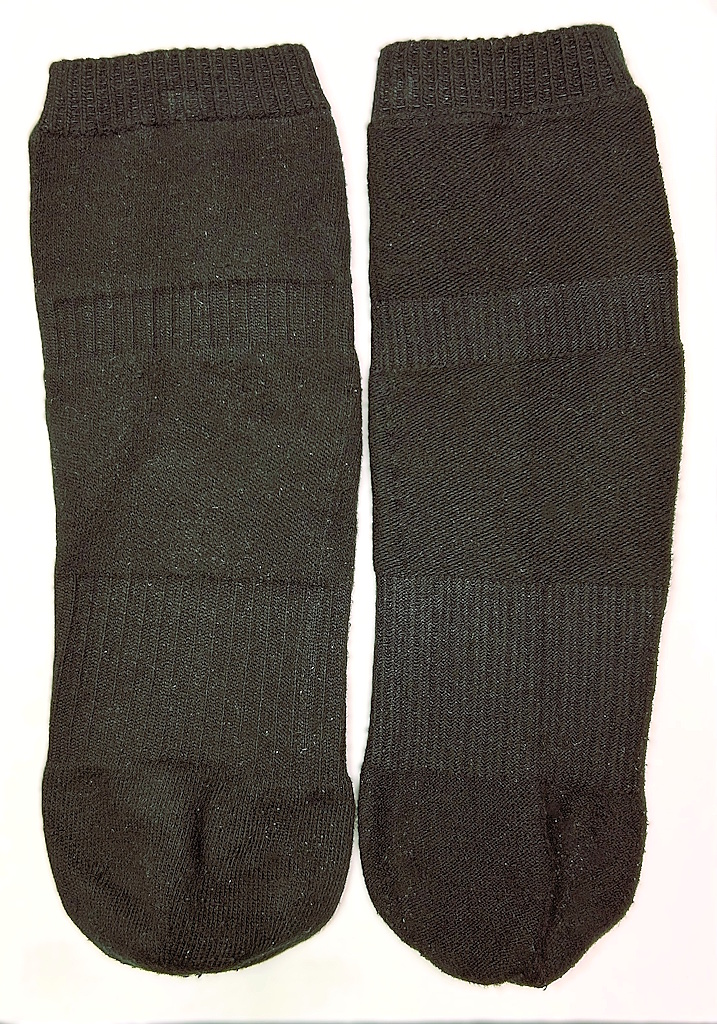
Tireless Socks are socks that utilize patented technology from Nishigaki Socks Co., Ltd. (Yamatokada City, Nara Prefecture), which was also featured in the Japan Patent Office’s newsletter “Tokkyo” Vol. 65. Attracted by the colorful design, I decided to order a pair to try them out.

Tireless Socks Tireless Socks

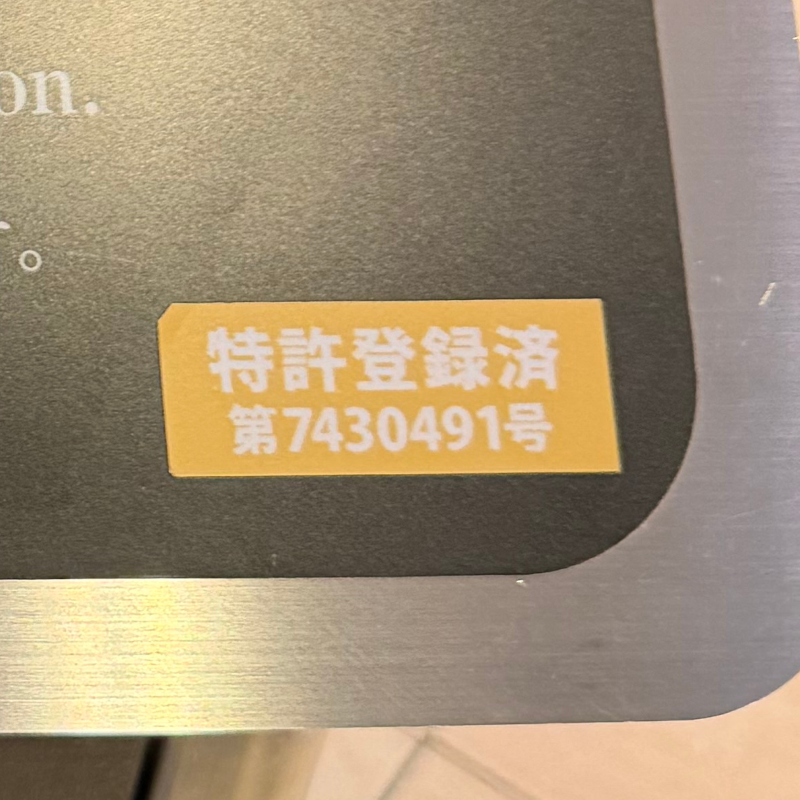
According to the website, these are “high-performance socks that reduce fatigue through a special taping knit, non-slip woven grips, and cushioned knitting on the sole.” While the product packaging only mentions cushion knitting as a patented technology, it appears that grip knitting is also a patented feature.

Tireless Socks

When I tried them on, the cushioning under the arch felt very firm. Essentially, it feels like the type of insole you’d place inside your shoe is attached to the sock itself. Also, even though there isn’t any obvious anti-slip material visible at first glance, they were surprisingly slip-resistant, making them easy to walk in and comfortable.

These days, you can buy a wide variety of functional socks at local home improvement stores and workwear specialty shops. Even something as simple as the way a sock is knitted has a lot of depth to it. I really feel the power of the inventions and ingenuity that drive the world forward, and it gives me a sense of reassurance.

Please note that the used trademark “Tsukare shirazu no Kutsushita (Tireless Socks)” is registered as “Tsukare shirazu no Kutsushita (Tireless Socks).”
(blink)

Grave Demolition Business Model

  • 2026年03月11日
#patent #trademark

 “Grave demolition” refers to the process of removing existing graves, clearing the land, and returning it to the land administrator. The exhumed remains are generally reinterred in perpetual care graves or columbariums. In recent years, demand for grave dismantling has increased due to factors such as population concentration in major cities, aging and declining birth rates making it difficult to manage rural cemeteries, and rising rates of lifelong unmarried individuals and declining birth rates leading to a lack of successors to manage graves. Consequently, specialized businesses offer “grave dismantling services” that bundle grave removal, handling administrative procedures for reinterment permits, and arranging reinterment locations. For example, one company operates under the registered trademark “Grave Closure SOS” (Trademark Registration No. 5958751).
https://www.bishoo.co.jp/hakajimai_sos.html

 Another company has patented and registered an invention called the “Remains Consolidation System” (Patent Publication No. 7370611). This system involves, upon the death of the final inheritor, reburying the remains of the final inheritor and specified relatives within a defined scope into a consolidated grave and conducting memorial services for a set period. The patent specification states: “Use of this system incurs necessary operational costs. Regarding these costs, it is conceivable that the administrator could receive the necessary amount from the final inheritor’s estate (inherited property) after their death. However, complications in receiving these costs are also anticipated due to factors like the existence of heirs. Therefore, the optimal approach is for all necessary expenses to be paid at the start of system usage.”
 Grave closure is also a theme I must resolve in my own future life. (Conan)
※ The photo is unrelated to the text.

Grave Demolition

Mount Fuji in a Flash: Learning Initial Response in Intellectual Property from a Shinkansen Window

  • 2026年02月25日
#design #intellectual property #patent #trademark

 Hello, this is Hiro.
 The other day, I took a photo of Mount Fuji from the window of the Shinkansen heading to Tokyo on a business trip. The visible time was surprisingly short. To catch the moment between passing buildings, I pressed the shutter the instant I thought, “This is it.” A split-second difference drastically changes both the captured scene and the impression.

Mount Fuji

 In the world of intellectual property, this “initial response” also determines the outcome. The moment a new product or service is unveiled, the risk of imitation skyrockets. Simultaneously, the available protection options later on (i.e., the “scope that can be protected”) can narrow.
 For instance, with technology (patents) and design (design patents), the timing of disclosure is crucial from a novelty standpoint. Naming (trademarks) is also an area where acting early generally offers an advantage. Preview posts on social media, early listings on e-commerce sites, or “peek-a-boo” reveals at trade shows – that first step can sometimes make subsequent applications or negotiations much harder.
 In reality, stories like “I tested reactions on Instagram before launch, only to see similar products appear the next month” are not uncommon. While some fields (patents, designs) offer remedial systems (so-called exception provisions) even after disclosure, these come with requirements and deadlines and are not universal solutions. This is precisely why considering and preparing applications before disclosure is a highly cost-effective risk management strategy.

 A glimpse of Mount Fuji from a train window passes in an instant, but the “publication” of your business (ideas, designs, naming) remains online, continuously exposed to public view. When you have an idea, start by planning how to protect it. Acting early allows you to “design” how to secure rights and manage disclosure.
 For intellectual property consultations (initial checks for patents, designs, trademarks, etc.), please feel free to use our contact form.

I Became Santa Claus🎅

  • 2025年12月25日
#design #patent #trademark #utility model

Book Santa is a social contribution project launched by the certified NPO Charity Santa in collaboration with bookstores to send books to children facing experiential disparities due to various hardships. You can participate at 1,851 bookstores nationwide. The slogan is “You can be someone’s Santa Claus.”
At participating bookstores, when you pay for a chosen book, you receive a leaflet and sticker like the ones pictured.

Book Santa

While donations at bookstores seem to end at Christmas, donations for operational costs, crowdfunding, and “Share Cake” (operated by the same Charity Santa NPO) appear to be available year-round.
“Book Santa” and “Share Cake” are registered trademarks of the Charity Santa NPO.
Also, out of curiosity, I did a quick search for “Santa Claus” on J-PlatPat. It turned up 15 patents/utility models, 11 designs, and 31 trademarks. Surprisingly many, huh?
Next year, I think I’ll become someone’s Santa Claus again with #BookSanta. (Marron)

Book Santa Official Homepage
https://booksanta.charity-santa.com/

M-1 Grand Prix

  • 2025年12月25日
#patent #trademark

“M-1 Grand Prix” is a manzai comedy contest for young comedians who have been performing together for 15 years or less. Established in 2001, it will be held for the 21st time this year, 2025, after a four-year hiatus. Both professional and amateur comedians can enter. This year saw a record-breaking entry of over 11,000 pairs. I hear a college duo from the rakugo research club I know also gave it a shot.
“M-1 Grand Prix” is trademarked in standard characters (Registration No. 5757035). The trademark owners are Asahi Broadcasting Corporation and Yoshimoto Kogyo Co., Ltd.
https://www.j-platpat.inpit.go.jp/c1801/TR/JP-2014-100187/40/en

Searching patent documents containing “manzai” in the specification reveals that Japanese Patent Application Publication No. 2022-128994 discloses an invention for an idea intermediation system and method. This system mediates the provision of ideas, including manzai routines and original rakugo stories. This invention is a system and method for linking user requests for ideas with existing information stored in a memory unit on a network-connected management server. This invention enables idea support by effectively utilizing existing information.

Manzai

I believe the humor in comedy routines comes not only from the material itself but also heavily from the performers’ skill. This year’s M-1 Grand Prix finals are scheduled for Sunday, December 21st. I look forward to enjoying the routines and performance skills of the duo who made it through from over 10,000 entries. (Conan)

(Reference site)
M-1 Grand Prix Official Website

Waymo Self-Driving Taxis

  • 2025年11月17日
#patent

Did you know there are self-driving, driverless taxis?

While not in Japan, companies like Waymo—part of Alphabet Inc., the same parent company as Google—are actually operating self-driving taxi services in urban areas like San Francisco and Los Angeles in the United States. Just like Uber taxis, which are now widely used in Japan, you simply download the app, enter your pickup location and destination, and Waymo will come to pick you up just like a regular taxi. Since your credit card information is linked during app registration, payment is automatically processed after the ride, eliminating any hassle.

A friend recently rode one. They found it strange there was no one in the driver’s seat, but said it arrived safely at their destination just like a regular taxi. They also enjoyed the comfort of not needing to tip—a must in the US—and not having to worry about the driver. Differences from regular taxis include opening/closing doors via the app, the vehicle starting automatically once you fasten your seatbelt, being able to set your preferred music genre after boarding, and knowing the estimated arrival time, making it seem more convenient.

Waymo appears to be a global pioneer in autonomous driving, holding numerous patents including Japanese Patent Registration No. 7712751 (Thermal imaging for self-driving vehicles) and Japanese Patent Registration No. 6985523 (Determining and responding to internal conditions of a vehicle).

In Japan, test drives have begun in Tokyo. I think it would be convenient not only for tourist areas but also as taxis for the elderly in depopulated areas, or as privately owned vehicles that even people with limited mobility could drive, enabling their use for picking up and dropping off children. I look forward to the continued evolution of autonomous driving technology. (Chamomile)

Waymo – Self-Driving Cars – Autonomous Vehicles – Ride-Hail
https://waymo.com/intl/jp/waymo-in-japan/ (Japanese)

Ballpoint Pen Drawings

  • 2025年09月29日
#Inventions of the Day #patent

Today (September 29th), I will introduce an invention closely related to this date.
This time, I will feature the ballpoint pen.

September 29th marks the birthday of Hungarian-born inventor László Bíró (1899.9.29-1985.10.24), who obtained the first practical ballpoint pen patent.
 That said, the technology behind ballpoint pens and the story of László Bíró are already widely known (1, 2). Therefore, this time I will introduce ballpoint pens as an art medium (ballpoint pen drawings), which is quite different from their image as writing instruments.

Polo_Pony,_ballpoint_biro_drawing
James Mylne, CC BY-SA 3.0, via Wikimedia Commons

Mona_a'la_Mace_in_ballpoint_pen_by_Lennie_Mace_1993_(shown_cropped)
Lennie Mace, CC BY-SA 3.0, via Wikimedia Commons

We rely on ballpoint pens daily, both at work and home. But haven’t you ever gotten annoyed when the ink clogs and your writing gets messy? I certainly have (laugh). For someone like me, it’s hard to believe those beautiful drawings above could be created with that same ballpoint pen.
Even if such artistic use seems impossible, using a Spirograph gear-based drawing tool? seems like it could let amateurs create pretty patterns.

Various_Spirograph_Designs
See page for author, Public domain, via Wikimedia Commons

Incidentally, the Spirograph we know today is an educational toy developed by English inventor Denys Fisher (3, 4(PDF)). It became a craze in Japan in the late 1960s (Showa Era year 40s). Nowadays, similar products are sold under names like “Spinning Ruler” or “Design Ruler”.
(blink)

Career Yearbook 2025: Introducing Jobs for Elementary and Junior High School Students

  • 2025年09月10日
#intellectual property #patent #patent attorney

 The Asahi Student Newspaper recently published “Career Yearbook 2025”.
Asahi Student Newspaper Career Yearbook 2025”(Japanese only)

Career Yearbook 2025

 The “Career Yearbook” is a career education resource for elementary and junior high school students, first published in 2016 as part of the career education support project “Career Museum.” Each year, with the cooperation of leading Japanese companies and organizations, it introduces various jobs and people who support society.
 It is structured so children can enjoy learning about the world’s jobs through a format where companies and organizations answer their simple questions, such as: “What are gummy candies made of?”, “Why can heavy rockets fly into space?”, “Is it true animals might disappear from Earth?”, and “What kind of pen is a highlighter?”.

・The work of patent attorneys is also featured
 “Career Yearbook 2025” covers the work of over 110 companies and organizations, including the role of patent attorneys.

 The article, timed with the ongoing EXPO 2025 Osaka-Kansai World Expo, highlights the “Progress of the Telephone” over 55 years since the 1970 Osaka Expo. It uses a two-page spread to explain the role of intellectual property rights like patents and the contributions of patent attorneys throughout this evolution.
 A web version with a “Review Quiz” is also available. “From Black Telephones to Smartphones: Why Did the Telephone Evolve So Much?”(Japan Patent Attorneys Association) (Japanese only)

・Free distribution to schools, e-book version also available
 “Career Yearbook 2025” is distributed free of charge to approximately 30,000 elementary and junior high schools nationwide. It is also possible to purchase the commercial version or view the e-book version.

 I would be delighted if children reading this book find it a catalyst for considering their future paths and develop an interest in the work of patent attorneys. (Hiro)

Long-Life Bread

  • 2025年09月05日
#patent

September 1st is Disaster Prevention Day. I maintain a rolling stock of food for disaster preparation, and I found bread at a store which the expiration date is over a month. It’s sold by Komo Co., Ltd., headquartered in Komaki City, Aichi Prefecture. Unusually for bread, it’s also sold in vending machines and can be purchased at stations and airports. I see Danish pastries most often, but croissants and pies are also available.

Long-Life Bread

The reason for its long-term storage is reportedly the use of Panettone yeast, combined with minimizing moisture content to the absolute limit, which suppresses bacterial growth. I had assumed some additive was extending the shelf life, so learning it’s due to the yeast type makes me feel safe letting my kids eat it. When I actually gave it to my children, they said it tasted just as good as other bread with shorter shelf lives and ate several pieces.

Given its unique feature of an extended shelf life—something ordinary bread can’t achieve—I wondered if it held patents. Upon checking, I found it was indeed patented under Japanese Patent Numbers 1721291 and 2971634, though the patents have since expired.

Komo Co., Ltd. seems to be the pioneer and industry leader in long-life bread. As a local company, I want to keep buying their products to support them. Their goods are even being served at the ongoing Osaka-Kansai Expo! (Chamomile)

https://www.comoshop.jp/tokutyo/ (Japanese only)
https://www.atpress.ne.jp/news/437689 (Japanese only)

Illegal Part-Time Job Prevention System

  • 2025年07月16日
#patent

Recently, crimes involving illegal part-time jobs have become a serious social issue.

Illegal Part-Time Job

The Metropolitan Police Department has decided to implement a system that automatically detects illegal part-time job postings on social media using AI (reference site: Japanese only). Currently, police officers search social media posts and select those requiring warnings. However, under the new system, AI will automatically detect terms such as “short-term high-paying jobs” and classify risks into several categories.

Illegal Part-Time Job

Japanese Patent Publication No. 2025-52899 (Applicant: SoftBank Group Corp.) discloses an invention for a system to prevent illegal part-time jobs using generative AI. In this invention, a data processing system performs the following processes, for example.

Step 1: The generative AI-based system for preventing illegal part-time jobs initiates chat-based communication with job seekers.
Step 2: A data collection module collects detailed information about illegal part-time work through interactions with job seekers.
Step 3: The collected information is reported to police authorities via a communication module to prevent incidents.

I hope that such technology will contribute to the realization of a safe and secure society free from crime. (Conan)