Thank you for your continuing support and cooperation.
We would like to express our sincere gratitude to you for entrusting us with your patents, utility models, designs, trademarks, and other intellectual property rights for many years.
We are pleased to announce that we have established a Patent Professional Corporation.
Until December 2021, we were representing as an individual agent (in the name of Masaki Hattori), however, from January 2022, we will be shifting to representing as a corporation.
We are convinced that due to the establishment of a Patent Professional Corporation, we will be able to continue to provide more detailed and higher quality services to our clients in response to their various requests regarding intellectual property.
In particular, we believe that we will be able to provide a wide range of services in the areas of protection of intellectual property rights such as patents, utility models, designs, and trademarks in Japan, exploitation of such rights, anti-counterfeiting measures, and consulting.
With the establishment of the Patent Professional Corporation, all of us at the firm are determined to devote ourselves even more to our work.
We would like to take this opportunity to ask you for entrustment of new patent/utility model/design/trademark applications in Japan.
October 27, 2021
Yours sincerely,
Masaki HATTORI, Patent Attorney
Koichi OKADA, Patent Attorney
Hiroyuki INOUE, Patent Attorney
HATTORI & PARTNERS
Have a Break
- Written by Patent Attorneys, Patent Engineers, Trademark Engineers, Translators, and Administrative staff -
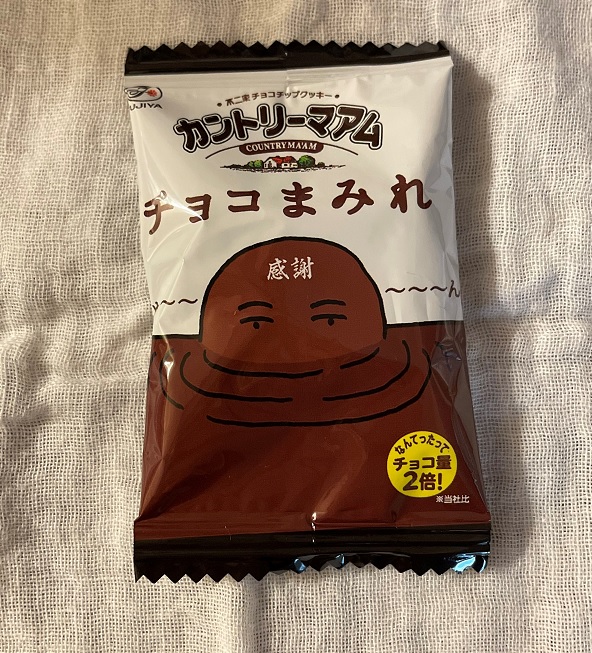
Chocomamire (covered in chocolate; the Japanese chocolate confectionary)
I would like to introduce a pack of sweets that I like recently. It is “Country Maam Chocomamire” by Fujiya Co., Ltd.
This sweet is made of chocolate dough of “Country Ma’am (popular Japanese sweets)” (with chocolate chips) coated with milk chocolate and it is really a full of chocolate as the name suggests.
When you hear this explanation, you may think that it would be “extremely sweet”, but it is not as sweet as I thought it would be, and it is moist and very easy to eat. Would you like it to accompany a long autumn night reading?
“チョコまみれ(Chocomamire)” was registered as a Japanese trademark on June 2, 2021 (Registration No. 6397058). (Sakuramochi)
Logicool Trackball ERGO M575
On my home PC, I use a trackball instead of a mouse. I think most people prefer mouse, but I’m for trackball.
In the case of a mouse, the mouse body is used to move the cursor on the screen by sliding it on the desk, but the trackball is the one that rolls the ball with your finger. It takes some time to get used to it at first.
The advantage of the trackball is that it can be used without moving it, which saves space, and the cursor can be moved without moving the arm, so there is less strain on the wrist and shoulders and mouse tendonitis can be prevented.
I started using it because I hurt my wrist while exercising, but the other day the trackball broke, so I replaced it.
The new trackball is ERGO M575 made by Logicool Co., Ltd.. As the name implies, it is a product that incorporates ergonomic design. You can use it without twisting your wrist at an unnatural angle, making it even more comfortable.
Logicool Co., Ltd. is a well-known brand of computer peripheral products and is a Japanese subsidiary of Logitech International, headquartered in Switzerland. The company has developed its products under the Logitech brand worldwide, but it seems that Logicool brand is used only in Japan. That is because Logitec Co., Ltd. already existed when the Japanese corporation was established. Logitec Co., Ltd. is also a company that deals with computer peripherals, and the trademark application of “Logitec” was filed in 1974, before the founding of Logitech in Switzerland.
The products of both companies are familiar to me and I have used them frequently for some time. (Syszo)
Logitech – Wikipedia
Logicool ERGO M575 (Japanese only)
What is mouse tendonitis? (Japanese only)
J-Plat Pat Japanese Trademark “Logitec”
Importance of checking properly
I saw illustrations in which the interesting image processing application was used, were shared on SNS that I use personally. The app is free to use and looks very fun so I wanted to try and use it. However, when I looked at the privacy section of the application store and the reputation on the internet, the terms said that the copyright, intellectual property rights, other rights of the pictures and images you drew are given to the sales company and the affiliated companies of the app so I decided not to download it.
This kind of wording can be seen in other apps, and it may be an unnecessary worry, but I think it’s best to be careful because the data you created may be used by third parties. (Swimmer)
Kaki-no-Tane
Kaki-no-Tane is a rice snack that I have been familiar with since I was little.
I went to buy some Kaki-no-Tane to see the position trademark registered by Kameda Seika Co., Ltd.
There are several kinds of Kaki-no-Tane, and on every package, there was the same trademark.
The text trademark on the package I bought this time is “Kameda Seika Kameda no Kaki-no-Tane” by Kameda Seika Corporation, Japanese trademark registration No. 4991187, registered on September 29, 2006.
The position trademark for Kameda Seika Co., Ltd. is Japanese Trademark Registration No. 5873740, registered on August 12, 2016.
Comparing the content of the currently registered positional trademark with the packaging I bought this time, the part that says “consisting of a figure attached to the upper left portion of a packaging container for rice crackers or bean confectioneries” and the part that says “a horizontal hexagon with a red bold line” are the same as the registered positional trademark, but the part that says “a vertical short ribbon shape in blue and the portions bordering both its left and right sides in white” is different.
The upper left part of the package I bought this time was not a ribbon shape, but a trapezoidal shape.
I thought that the positional trademark was easy to impress with its shape and color. Next time I buy Kaki-no-Tane, I would like to look at the trademark on the packaging. (Raspberry)
Patent application filed a year and a half ago
When a year and a half is passed since the filing of a patent application, a publication bulletin is issued, and everyone can know the contents of the application. It was on January 16, 2020 that the first infection of the new coronavirus was confirmed in Japan. After that, the latter half of January and February 2020 was the beginning of the Corona disaster. A patent from just that time has recently been published. (As of September 16, 2021, patent applications with filing dates up to around March 6, 2020 have been published, with exceptions such as early publication.)
So, I checked to see if there were any patent applications that were the first to describe terms such as “Three Cs,” “Social Distance,” “refrain from going out,” “stay home,” and “unnecessary and nonurgent,” which have come to be used a lot in the Corona disaster, but I could not find any. Based on the tendency of utility model bulletins to be published within three or four months of filing, we can guess that corona-related terms began to be included in application specifications probably from applications filed around April 2020.
So, when I was looking at the search screen to see what applications had been filed around February 2020, I happened to see an application by GURUNAVI INC. for “information processing system, information processing method, and program”. GURUNAVI INC. is a company that operates the GURUNAVI website, which accepts restaurant reservations and delivery orders.
GURUNAVI INC. has been consistently filing patent applications related to information processing for some time now; from 2017 to 2019, the company filed about 70 applications per year, an average of 5 to 6 per month. In contrast, I was curious to see that 12 applications were filed in the month from January 23 to February 21, 2020, which is double the average of the previous year. It may not be directly related to Corona, but was there any strategy behind it? I can only guess now, a year and a half later, that each company must have been thinking of various strategies in the early days of the Corona disaster. (Conan)
The technology of deliciousness
I like Ichimasa Kamaboko’s “Karikko” snack series, and whenever I see them at the supermarket, I can’t resist buying them. The texture is chewy and hard, and I can’t stop eating them. There are three types: sardine (Karikko Iwashi), shrimp (Karikko Ebi), and seaweed & hijiki seaweed (Karikko Wakame&Hijiki), but sardine is my favorite.
On the back, there is a patent number for the manufacturing method. (Japanese Patent No. 3816037)
I felt that the crunchy texture with the flavor of fish is supported by this kind of technology.
In addition, “Karikko Iwashi” and “Karikko” have been registered as Japanese trademarks.
This product is often found in supermarkets, not in the confectionary section, but in the section where fish paste and fish sausage are sold, so if you are curious about it, please look for it. (Marron)
KAKUSAN
The other day, my friend gave me a KAKUSAN face roller (beauty massager) as a birthday present.
When I used it the first time, my impression was painful. It was a feeling of being pulled while being pinched.
However, as I continued to use it, I got used to it and the pain disappeared.
Recently, I’ve been using it every night, so it doesn’t hurt as much as it did at the beginning, and I can easily roll around while watching TV.
“KAKUSAN” was registered as a trademark on February 26, 2016 (Japanese Trademark Registration No. 5829303), and the right holder is “深▲セン▼市カクサン有限会社(Shenzhen KKS Tech Co., Ltd.)” from China.
I rarely show my face now because of masks, but I would like to continue using it.
(Rabbit)
Gohei Mochi from Yotsuya Senmaida (Thousand Rice Paddies of Yotsuya)
The other day, I went to Toshika Shrine in Toyokawa City to have my car purified.
After the prayer, I was given a set of Gohei mochi as a gift. It was a set of vacuum-packed Gohei mochi and Hatcho miso sauce.
The rice used is Mineasahi rice grown in the Senmaida rice field in Yotsuya, and the skewers are made of cedar wood from near Horaiji Mountain. In addition to a leaflet on how to eat it, three pamphlets were enclosed, showing the many particulars and thoughts of the producers.
According to J-PlatPat, the product name “Yotsuya Senmaida” branded on the skewers has been applied for as a Japanese trademark application. As the application is under examination, I read the argument in response to the notice of reasons for refusal and was able to catch a glimpse of the applicant’s contribution to regional revitalization through “Yotsuya Senmaida,” a regional and tourist resource.
I would like to enjoy the Gohei mochi while thinking about the Senmaida rice field in Yotsuya, which I have yet to visit. (Cacao)
Dynamic Random Access Memory (DRAM)
Today, I would like to introduce an invention related to September 5. What I will introduce this time is dynamic random-access memory (DRAM) devised by American electronical engineer and inventor Robert H. Dennard (1932.9.5 ~). Today, September 5th, is his 89th birthday.
DRAM is a type of semiconductor memory. It has the disadvantage of constantly consuming power for refreshing (memory retention operation) because information is lost when it is discharged, but it is widely used in computers’ main storage devices, digital televisions, and digital cameras, etc. due to its large capacity and low cost.
Currently, all the main storage devices of computers are DRAM. In recent years, DRAMs that specialize in low power consumption have also appeared.
The DRAM we use every day was conceived by Dennard in 1966 at IBM Thomas J. Watson Research Center. The following year of 1967, a patent application was filed, and it was registered in 1968 (US3387286A). Dennard also won the Kyoto Prize in 2013.
By the way, IBM Thomas J. Watson Research Center is a research division of IBM. In addition to Dennard, it is known that many prominent scientists such as Benoit Mandelbrot in mathematics and Leo Esaki in physics also worked there.
Related Link: Robert H. Dennard – Wikipedia
(blink)